Call for Papers: Scopus Indexed Journals Accepting Submissions in 2025
A practical guide to Call for Papers in Scopus-indexed journals for 2025. Learn how to find relevant journals, verify submission status, and choose the best option.
For thousands of researchers around the world—especially graduate students, early-career academics, and professionals aiming for promotion—the phrase “Call for Papers” appears everywhere on academic websites and social media. But what does it really mean? And more importantly, how do you find Scopus-indexed journals that are accepting submissions in 2025?
This article provides a complete, practical, and step-by-step guide that any researcher can use to discover relevant Scopus journals in their field, identify active calls for papers, and understand how to submit successfully. No journal names will be mentioned; instead, you’ll learn how to find them yourself safely and accurately.

A Call for Papers (CFP) is an official invitation issued by an academic journal, conference, or special issue editor requesting researchers to submit manuscripts for consideration.
A CFP usually includes:
The theme or research focus
The submission deadline
Manuscript requirements
Submission portal
Contact information for the editorial office
Information about indexing (such as Scopus, WoS, or ESCI)
A Call for Papers does not guarantee acceptance—it only means the journal is actively looking for new submissions within a certain area.
For researchers, a CFP is valuable because:
It confirms the journal is open for new manuscripts
It often indicates faster review timelines, especially for special issues
The scope is very clearly stated, making it easier to match your research
It helps avoid submitting to journals that are temporarily closed or backlogged with submissions
Understanding CFPs is the first step toward finding journals that match your work and timeline.
Scopus-indexed journals across all fields of study are currently accepting submissions for 2025. These include:

Medicine
Public health
Nursing
Pharmacy
Dentistry
Allied health
Computer science
AI and machine learning
Electrical engineering
Mechanical engineering
Civil engineering
Chemical engineering
Management
Accounting
Finance
Economics
Marketing
Entrepreneurship
Psychology
Sociology
Education
Political science
Linguistics
Communication
Biology
Chemistry
Environmental sciences
Physics
Mathematics
Earth sciences
Literature
Philosophy
History
Fine arts
Cultural studies
All these fields have Scopus-indexed journals with open calls for 2025.
But how do you find which ones are actively accepting submissions?
That’s what the next section explains.
Below is the most practical, real-world method researchers can use. No guessing. No relying on secondhand information.
Each method teaches you how to locate journals that match your field and are currently open for submission.

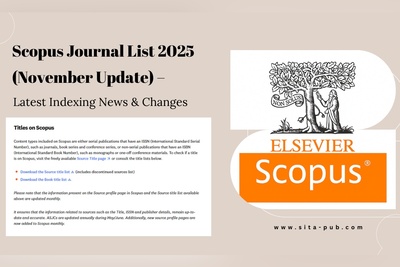
Scopus maintains an updated database of all indexed journals.
Search online for “Scopus Sources” (Elsevier official).
Open the website and download the Excel file.
Use the filters to select:
Subject area
Sub-subject
Publisher
Country
Once filtered, open each journal’s website through the provided link.
Check for:
“Submit Manuscript” button
“Call for Papers” section
“Open for submissions” notice
“Manuscript submission portal”
If the journal is actively accepting submissions for 2025, this information will always appear clearly.
Many Scopus journals publish special issues on trending topics. These often have shorter review timelines and very clear CFP announcements.
Elsevier Special Issues
Springer Special Issues
Taylor & Francis Calls for Papers
Wiley Special Issues
MDPI Topical Collections
IEEE CFP lists
Each special issue has:
A clear research theme
A deadline
Submission guidelines
Editor contact details
For researchers who want fast acceptance, special issues are excellent opportunities.
You can find suitable Scopus journals by simply inserting your title and abstract.
Popular tools include:
Elsevier Journal Finder
Springer Journal Suggester
Taylor & Francis Journal Finder
IEEE Publication Recommender
Wiley Journal Finder
These tools do not guarantee that the journals are open for submissions, but they give you a filtered list based on relevance.
Most journals include clear notes on whether they are accepting new manuscripts.
Search for terms like:
“Call for Papers”
“Now accepting submissions”
“Open Issue 2025”
“Submit Your Manuscript”
“New manuscripts welcome”
“Ongoing submissions”
Any reputable Scopus-indexed journal will always keep this information updated.
Some academic portals list active calls from Scopus journals.
Examples include:
CFP alert websites
Academic society portals
University journal directories
ResearchGate CFP posts
You can filter by:
Field of study
Submission deadline
Type of publication
Open access or free publication
If you don’t have time to manually search for journals—or you’re unsure which journals match your research—academic support services can help.
These services usually provide:
A custom list of relevant Scopus journals
Indexing verification
Fees (APC)
Acceptance and publication timelines
Instructions for submission
Formatting and editing support
For researchers with tight deadlines, this option saves a significant amount of time.
Some journals stop accepting new manuscripts when their pipeline is full.
Always check:
If it is updated for 2025, the journal is active.
If it allows uploading a manuscript, the journal is open.
If the latest issue is labeled "2025", the journal is active.
Many journals send CFP notifications on their website or mailing list.


Read the Aims & Scope page.
Some journals publish:
"Average time to first decision"
"Average acceptance time"
Some Scopus journals are free; others have APCs.
Most researchers aiming for fast acceptance choose:
Q3
Q4
ESCI
Verify indexing only from official databases.
A Call for Papers is your opportunity to publish in a Scopus-indexed journal that is actively accepting submissions. Whether your field is medical sciences, engineering, social sciences, business, arts, or pure sciences, there are hundreds of journals seeking manuscripts in 2025.
By using:
The Scopus Source List
Special issues
Journal finder tools
Publisher CFP portals
Direct website search
Or publication support services
You can easily locate journals that match your research, scope, budget, and timeline.
This guide ensures you can begin your publishing journey with confidence—efficiently, accurately, and safely.
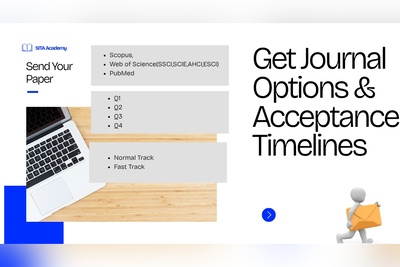
If you’re planning to submit your research to a Scopus-indexed journal in 2025 but aren’t sure which journals are currently accepting papers, SITA Academy can help.
We specialize in supporting researchers with accurate, personalized, and fast journal recommendations.
Our team analyzes your research field, abstract, keywords, scope, and publication goals to prepare a tailored list of journals that:
Are officially indexed in Scopus
Are currently accepting submissions (CFP or regular submissions)
Match your research topic and methodology
Have transparent review times and realistic acceptance rates
Include information on APC fees, editorial policies, and publication timelines
When you send your abstract and research scope, you will get a complete report containing:
A curated list of relevant Scopus-indexed journals
Submission options (regular issues or 2025 Calls for Papers)
Journal requirements and author guidelines
Expected review and publication timelines
APC / open-access fee details
Direct submission links

Simply send us your:
Research title
Abstract
Field of study / keywords

And our team will analyze everything and send you a personalized recommendation list designed to maximize your acceptance chances and reduce the publication timeline.
If you have any questions, inquiries, or would like to learn more about our services, please don't hesitate to reach out to us. Our dedicated team is ready to assist you.