Turn Your Unpublished Master’s Thesis into a Publishable Journal Article
Learn how to turn your unpublished Master’s thesis into a publishable journal article. Ethical extraction, confidentiality, Scopus & WoS journal options, and professional publication support.
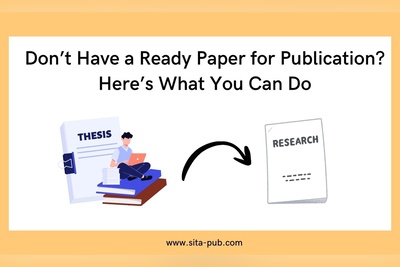
Many researchers complete a Master’s thesis that contains valuable, original research—yet it remains unpublished. In most cases, this is not due to poor quality, but because a thesis is not written in a format suitable for journal publication. Journals require concise, focused, and highly structured articles, while theses are long, descriptive, and designed for academic examination rather than international publishing.
This article explains how an unpublished Master’s thesis can be safely and ethically converted into one or more publishable journal articles, what the process involves, and how professional thesis-to-article extraction can significantly improve publication success in Scopus- and Web of Science–indexed journals.
Is It Allowed to Publish an Article from an Unpublished Master’s Thesis?
Yes. Publishing journal articles derived from an unpublished Master’s thesis is fully acceptable and widely practiced in academia.
A thesis is considered an academic manuscript, not a journal publication. As long as:
The thesis has not been published as a journal article elsewhere, and
The extracted article is rewritten to meet journal standards,
there is no ethical or legal issue with submitting it to international journals.
In fact, many universities expect students to publish articles based on their theses after graduation.
Confidentiality and Ownership of Unpublished Theses
One of the most common concerns researchers raise is confidentiality.
When you submit an unpublished thesis for article extraction:
You retain full ownership of your research
The content is used only for extraction and publication preparation
No submission is made to any journal without your explicit approval
At SITA Academy, all theses are handled under strict confidentiality protocols. Files are reviewed solely for extraction purposes, and the publication process begins only after researcher confirmation.
What Journals Accept Articles Extracted from Master’s Theses?
Most reputable international journals accept articles derived from theses, provided that:
The manuscript fits the journal’s scope
The article is original in structure and presentation
It meets formatting, methodological, and language standards
Articles extracted from Master’s theses are regularly published in:
Scopus-indexed journals
Web of Science (WoS) journals
Discipline-specific indexed journals across sciences, engineering, social sciences, and humanities
The key is correct journal selection, which depends on topic focus, methodology, and acceptance criteria.
Which Parts of the Thesis Are Used in a Journal Article?
A thesis cannot be submitted “as is.” It must be significantly condensed and restructured.
Sections Usually Removed
Extended literature review chapters
Detailed theoretical background sections
Methodological justifications written for examiners
Appendices, questionnaires, raw data, and tables
Sections That Are Shortened
Introduction (focused on the research gap only)
Literature review (condensed and selective)
Methodology (clear, but concise)
Discussion (focused on key findings only)
Core Sections Retained
Research problem and objectives
Methodology and data analysis
Main findings and conclusions
Key references relevant to the article
How a Thesis Is Condensed into a Journal-Length Article
A typical Master’s thesis may be 25,000–60,000 words. A journal article usually ranges between 5,000 and 8,000 words.
Condensation involves:
Narrowing the research focus to one clear contribution
Removing descriptive or repetitive explanations
Rewriting content to follow a journal article structure
Ensuring coherence, clarity, and compliance with journal guidelines
This is not simple editing—it is professional academic restructuring.
How Many Articles Can Be Extracted from One Master’s Thesis?
Depending on the thesis scope, one to three publishable articles may be extracted.
For example:
One article focusing on the main empirical findings
Another article addressing a specific sub-question or dataset
In some cases, a methodological or comparative article
This assessment must be done before any writing begins.
Common Reasons Thesis-Based Articles Get Rejected
Many thesis-based submissions are rejected due to:
Submitting to the wrong journal
Poor alignment with journal scope
Overly long or unfocused manuscripts
Weak academic English
Failure to follow journal formatting guidelines
These issues are avoidable with proper extraction and journal targeting.
SITA Academy’s Thesis-to-Article Extraction Process
The process works as follows:
You submit your unpublished Master’s thesis
The thesis is reviewed to identify:
How many articles can be extracted
Proposed titles for each article
You receive:
A list of extracted, publishable article titles
You review and approve:
Which article(s) to proceed with
No writing, submission, or publication step begins without your confirmation.
Sending You the Extracted Articles with Journal Recommendations
Once approved, you receive:
Fully extracted, journal-ready articles
Each article matched with suitable Scopus or WoS journals
Clear information on indexing, scope, and submission suitability
This ensures transparency and full researcher control.
Language Is Not a Barrier
Your thesis does not need to be written in English.
Theses written in:
Arabic
French
Russian
Or any other language
can be:
Professionally translated into academic English
Edited to meet international journal standards
Submitted to Scopus- and Web of Science–indexed journals
Language is handled as part of the extraction and preparation process.
Optional Publication Assistance
If you require further support, publication assistance may include:
Journal recommendation based on indexing and acceptance goals
Formatting according to journal guidelines
Submission coordination and follow-up
This support is optional and begins only after journal selection is finalized by you.
How to Get Started
To begin:
Send your unpublished Master’s thesis
The review is conducted free of charge to determine:
An unpublished Master’s thesis is often a strong foundation for one or more international journal publications. With correct extraction, restructuring, translation (if needed), and strategic journal selection, your research can reach indexed journals and contribute to your academic and professional goals.
If you are ready to explore how your thesis can become a publishable article, professional guidance can make the process clear, efficient, and reliable.
Verified Contact Channels
If you have any questions, inquiries, or would like to learn more about our services, please don't hesitate to reach out to us. Our dedicated team is ready to assist you.
1.
Can I publish a journal article from an unpublished Master’s thesis?
Yes. Publishing articles derived from an unpublished Master’s thesis is fully acceptable and widely practiced. A thesis is not considered a journal publication, provided the article is properly rewritten to meet journal standards.
2.
Will my thesis remain confidential if I submit it for article extraction?
Yes. Your thesis remains confidential at all stages. You retain full ownership of your research, and no submission to any journal is made without your explicit approval.
3.
Do journals accept articles extracted from theses?
Yes. Many reputable Scopus- and Web of Science–indexed journals accept articles derived from theses, as long as the manuscript is original in structure, aligned with the journal’s scope, and meets academic and formatting standards.