Turn your Thesis into a Publishable Research Paper - Thesis Publication
Finished your thesis? Learn how to convert your master’s or PhD thesis into journal articles, avoid rejection, and publish successfully in indexed journals.
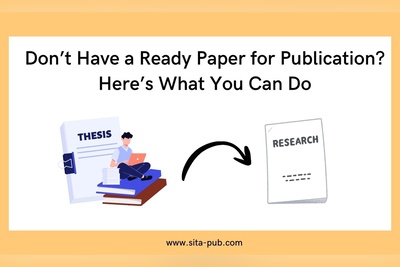
For many graduate students, completing a thesis is the final and most demanding step of their academic journey. However, finishing a thesis does not automatically mean that the research is ready for journal publication. In fact, one of the most valuable outcomes of a master’s or PhD thesis is its potential to be transformed into one or more publishable research papers.
Publishing from a thesis requires a clear strategy, careful restructuring, and an understanding of journal expectations. This article provides a practical guide on why thesis publication matters, the challenges researchers face, and how to successfully convert a thesis into a journal-ready manuscript—either independently or with professional support.

A thesis represents months or years of original research, data collection, and analysis. Leaving it unpublished limits its academic and professional impact.
Fulfills graduation or degree completion requirements in many institutions
Strengthens an academic CV for postdoctoral or faculty positions
Increases citations and research visibility
Enhances credibility as a researcher
Improves competitiveness for grants and funding
Demonstrates research productivity to employers
Contributes to university rankings and research output
Supports accreditation and quality assurance requirements
Despite these benefits, many theses never reach journals due to structural and technical barriers.
Graduate researchers often struggle with thesis publication for several reasons:
Language barriers: Many theses are written in languages other than English, while most indexed journals require high-quality academic English.
Online availability: Theses are often uploaded to university repositories, which may trigger plagiarism concerns if not handled correctly.
Length and structure: A thesis is significantly longer and more descriptive than a journal article.
Uncertainty about journal selection: Researchers may not know which journals are suitable for thesis-based papers.
Technical requirements: Formatting, referencing styles, plagiarism limits, and ethical statements can be overwhelming.
These challenges explain why a thesis, in its original form, is rarely suitable for direct journal submission.

A thesis and a journal article serve different purposes and audiences. A thesis is written to demonstrate research competence to examiners, while a journal article is written to communicate specific findings to a global research audience.
Key differences include:
Excessive literature review and background sections
Detailed methodology that exceeds journal limits
Multiple research questions instead of one focused objective
Redundant explanations and appendices
Submitting a thesis chapter directly to a journal often leads to desk rejection, not because the research lacks value, but because it does not meet journal standards.
Researchers generally have two options: using article extraction from thesis services or doing the process independently.
Professional thesis publication services begin by reviewing your entire thesis to identify its publication potential. This is a critical first step that many researchers skip.
Typically, these services:
Analyze the thesis to determine how many publishable papers can be extracted
Propose article titles and scopes based on the strongest findings
Recommend suitable journals aligned with each article
Offer end-to-end publication support services
In addition, these services often provide essential technical support, such as:
Native English academic editing
Plagiarism checking and similarity reduction
Structural and formatting adjustments
Journal submission and revision support
This approach saves time, reduces rejection risk, and ensures that the extracted articles meet international publication standards.
Researchers who prefer a DIY approach can extract articles from their thesis by following a structured process. The table below outlines a practical step-by-step method:
Step | Action | Notes |
1 | Identify core findings | Select one main research question or result |
2 | Choose article type | Original research, review, or case study |
3 | Reduce content | Remove excessive background and repetition |
4 | Restructure sections | Follow journal IMRaD format |
5 | Rewrite abstract | Focus on novelty and contribution |
6 | Translate if needed | Ensure accurate academic translation |
7 | Edit language | Improve clarity, flow, and academic tone |
8 | Check plagiarism | Address repository-related similarity |
9 | Format manuscript | Follow target journal guidelines |
10 | Select journal | Match scope, acceptance level, and timeline |
While possible, this approach requires significant time, strong academic writing skills, and familiarity with journal expectations.
Once article extraction is complete, journal selection becomes the next critical step.
Key considerations include:
Journal scope and audience
Indexing requirements (Scopus, Web of Science, etc.)
Acceptance rates and peer-review rigor
Publication timelines and issue frequency
A mismatch between the paper and journal scope is one of the most common reasons for rejection. Strategic journal selection significantly improves acceptance chances.

SITA Academy offers specialized thesis publication support designed for graduate researchers and early-career academics.
Key benefits include:
Free initial thesis or manuscript evaluation
Identification of publishable articles and suggested titles
Journal recommendation based on topic, quality, and timeline
Native English editing and technical enhancement
Plagiarism checking and similarity optimization
Professional support throughout submission and revision

This structured support helps researchers move from thesis completion to successful journal publication with confidence.
Publishing from a thesis is not an automatic process—it requires careful extraction, restructuring, technical preparation, and strategic journal selection. Whether you choose to do it yourself or work with professionals, understanding the process is essential to avoid rejection and delays.
Send your thesis or manuscript to SITA Academy for a free analysis.
Our experts will review your work, identify publishable articles, recommend suitable journals, and guide you through the entire publication process.
Turn your thesis into impactful, published research—efficiently and professionally.
If you have any questions, inquiries, or would like to learn more about our services, please don't hesitate to reach out to us. Our dedicated team is ready to assist you.