Learn why 100% acceptance cannot be promised and how researchers can increase their chances of acceptance to over 90% through expert journal selection, editing, and ethical publication support.
Introduction: Why Researchers Ask About Guaranteed Publication
Researchers across the world—graduate students, PhD candidates, university professors, and independent scholars—often ask the same question: “Can my paper be guaranteed for publication?”
This question usually comes from real pressure. Publishing is required for thesis completion, academic promotion, funding applications, and career advancement. Rejections cost time, money, and confidence. As deadlines approach, the idea of “guaranteed publication” becomes very attractive.
However, academic publishing does not work like a commercial approval system. To understand what is truly possible—and what is not—it is important to first understand how journals operate and what “guaranteed publication” actually means in practice.
What Does “Guaranteed Publication” Really Mean?
In academic publishing, guaranteed publication would mean that a paper will be accepted regardless of reviewer feedback, editorial judgment, or journal policies.
In reality, no reputable journal offers this. Journals indexed in Scopus, Web of Science (SCIE, SSCI, ESCI, AHCI), PubMed, or other recognized databases make independent decisions based on peer review.
When agencies claim “100% guaranteed publication,” they usually mean one of the following:
Submission to low-quality or predatory journals
Publishing in journals with weak or questionable peer review
Making misleading promises that ignore editorial independence
True academic publishing is based on evaluation, not assurance. Ethical support focuses on preparation and strategy, not guarantees.
How Academic Journals Make Acceptance Decisions
Understanding the decision-making process helps explain why guarantees are impossible.
Most academic journals follow these steps:
Initial Editorial Screening The editor checks whether the paper fits the journal’s scope, structure, and quality standards.
Peer Review Independent experts evaluate originality, methodology, clarity, relevance, and contribution to the field.
Reviewer Recommendations Reviewers may suggest acceptance, minor revision, major revision, or rejection.
Final Editorial Decision The editor considers reviewer feedback and journal priorities before making the final decision.
At no stage does an external service control the outcome. Even strong papers can be rejected due to space limitations, journal focus, or reviewer perspectives.
Why 100% Guaranteed Publication Is Not Possible
There are several clear reasons why guaranteed publication cannot exist in legitimate academic publishing.
First, journals are independent institutions. Editors and reviewers are not influenced by third parties.
Second, peer review is subjective. Different reviewers may interpret quality, novelty, or importance differently.
Third, ethical publishing standards prohibit any form of acceptance manipulation. Journals that bypass review risk removal from indexing databases.
For these reasons, any promise of guaranteed publication should be treated with caution.
The Real Reasons Research Papers Get Rejected
Most rejections are not because the research is “bad.” They usually occur due to avoidable issues.
Common rejection reasons include:
Submitting to a journal that does not match the paper’s scope
Weak academic writing or unclear structure
Poor English language quality
High similarity or plagiarism issues
Ignoring journal formatting and submission guidelines
Inadequate response to reviewer comments
These problems can be addressed systematically—and this is where acceptance rates can be significantly improved.
What Can Be Controlled in the Publication Process
While acceptance itself cannot be guaranteed, many critical factors are fully controllable. Managing these properly can drastically reduce rejection risk.
Researchers can control:
Where the paper is submitted
How well the manuscript is written and structured
Language quality and clarity
Ethical compliance and originality
Formatting accuracy
Quality of revision responses
When these elements are handled professionally, the paper enters peer review in its strongest possible form.
How Acceptance Rates Can Be Increased to 90% or More
Although no one can promise acceptance, professional preparation can raise acceptance probability to over 90% in suitable journals. Below are the most effective strategies.
Strategic Journal Selection
Journal selection is the single most important factor in acceptance.
A paper should be submitted only to journals that match:
Research scope and topic
Methodology and article type
Acceptance rate history
Review and publication timeline
Indexing requirements (Scopus, WoS, etc.)
Submitting a strong paper to the wrong journal almost always results in rejection. Correct matching alone can dramatically improve success rates.
Even strong research can be rejected if the manuscript is not structured according to journal standards. Academic journals expect papers to follow a clear, logical, and discipline-appropriate structure.
Proper manuscript preparation includes:
Organizing sections according to the target journal’s requirements
Strengthening the introduction to clearly present the research problem and contribution
Ensuring the methodology, results, and discussion are clearly separated and well explained
Improving the abstract and keywords to reflect the core findings accurately
Ensuring smooth flow and coherence between sections
A well-prepared and properly structured manuscript makes it easier for editors and reviewers to assess the quality, relevance, and contribution of the research—significantly improving the chances of acceptance.
Plagiarism Checking and Ethical Compliance
Most journals use similarity detection tools before peer review.
Professional plagiarism management includes:
Similarity checking using trusted software
Ethical paraphrasing and rewriting
Proper citation and referencing
Compliance with publication ethics
A clean similarity report removes one of the biggest barriers to acceptance.
Guaranteed publication does not exist in ethical academic publishing. However, high acceptance probability is absolutely achievable.
By controlling journal selection, manuscript quality, language clarity, ethical compliance, and formatting accuracy, researchers can realistically increase acceptance chances to 90% or more—without compromising integrity.
Professional publication support does not promise outcomes; it builds success systematically.
Maximize Your Journal Acceptance with Expert Support from SITA Academy
While guaranteed publication is not possible in ethical academic publishing, maximizing your chances of acceptance is. At SITA Academy, we help researchers prepare publication-ready manuscripts and submit them to well-matched journals with high acceptance potential.
Our experts support you at every stage, including:
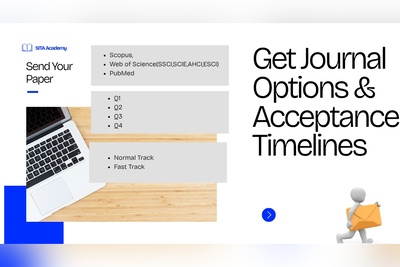
Journal selection based on scope, acceptance rate, and timeline
We will evaluate its publication potential and guide you toward the most suitable journals—professionally, transparently, and ethically.
Verified Contact Channels
If you have any questions, inquiries, or would like to learn more about our services, please don't hesitate to reach out to us. Our dedicated team is ready to assist you.
1.
What is a realistic acceptance rate for a well-prepared paper?
With proper journal selection, strong writing, ethical compliance, and professional formatting, acceptance rates can realistically exceed 90% in suitable journals.
2.
Why do some services claim “100% guaranteed publication”?
Such claims are usually misleading. They may involve low-quality or predatory journals, or they may ignore peer-review standards. Legitimate journals never guarantee acceptance.
3.
How does SITA Academy help improve acceptance rates?
SITA Academy supports researchers through expert journal matching, native English editing, plagiarism checking, formatting, submission assistance.