What happens after I submit my paper to a journal?
Learn step by step what happens after you submit a research paper to a journal. Understand the peer review process, editorial checks, revisions, and final publication.
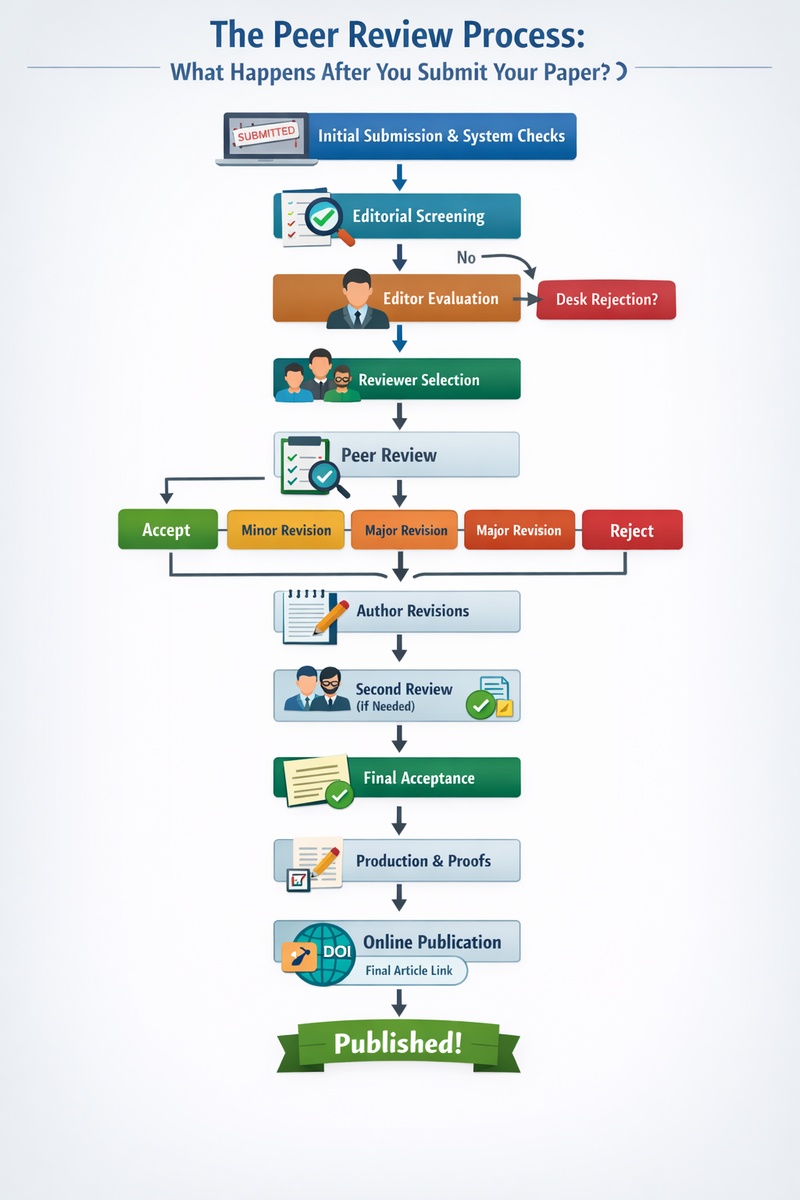
Submitting your research paper to a journal is an exciting milestone. But what happens after you hit that “Submit” button? Many researchers, especially early-career scholars, are unfamiliar with the journal review process. Understanding what occurs behind the scenes can help you navigate it effectively, avoid mistakes, and increase your chances of publication. This guide explains, step by step, what happens from submission to the final publication link.
The moment you submit your manuscript, the journal’s online submission system records it. You usually receive a confirmation email with a tracking number. This step may seem trivial, but it is crucial: it ensures your paper is logged in the system and will be tracked throughout the process.
At this stage, automated checks often occur:
File format (Word, PDF, LaTeX)
Figure resolution and quality
Word count against journal limits
Plagiarism checks using software like iThenticate
Your manuscript must pass these basic technical checks to move forward. Submissions with missing files, incorrect formats, or high plagiarism scores can be rejected immediately.
After passing system checks, the editorial office reviews your manuscript for technical compliance. The editorial assistants check:
All required sections (title page, abstract, keywords, references) are present
Figures and tables are properly labeled
Ethical statements, funding information, and author declarations are included
Adherence to journal style and referencing guidelines
If your manuscript does not comply with these requirements, it is returned to you for corrections or sometimes desk-rejected if noncompliance is severe.
Once the editorial office approves technical compliance, the Editor-in-Chief (EIC) or Handling Editor evaluates the paper for:
Scope: Does the manuscript fit the journal’s aims and readership?
Originality: Is the work novel, or is it a repetition of existing studies?
Scientific quality: Are the methodology and results reasonable?
At this stage, papers can be desk-rejected if they are out of scope, lack novelty, or do not meet basic scientific standards. Desk rejections are common and save both authors and reviewers time.
If the editor decides the paper is suitable, it is sent out for peer review. Otherwise, you may receive a desk rejection letter, usually including brief comments. Don’t be discouraged; desk rejection is not a reflection of your ability—it often reflects fit, clarity, or novelty issues.
Editors identify 2–4 experts in your field to review your manuscript. Reviewers are chosen based on:
Subject expertise
Previous publications on similar topics
Absence of conflicts of interest
Once selected, reviewers receive an invitation email. They can accept or decline. If they decline, the editor invites others. This stage can take 1–3 weeks, depending on reviewer availability.
Peer review is the heart of academic quality control. Reviewers evaluate your manuscript using several criteria:
1. Originality and Significance
Does the research address an important question?
Does it contribute new knowledge or methods?
2. Methodology and Accuracy
Are the experimental design, data collection, and analysis appropriate?
Are statistics correctly applied and interpreted?
3. Clarity and Structure
Is the manuscript logically organized?
Are figures, tables, and text clear and readable?
4. Ethical Compliance
Was research conducted ethically (human/animal studies)?
Are conflicts of interest and funding disclosures transparent?
Reviewers provide detailed comments and a recommendation:
Accept
Minor revision
Major revision
Reject
After receiving reviewer reports, the editor synthesizes feedback and makes the first decision. Common outcomes:
Accept: Rare on the first submission.
Minor Revision: Small changes like grammar, figure adjustments, or clarifying methods.
Major Revision: Significant changes in methodology, analysis, or discussion.
Reject: If the paper has fundamental flaws or is unsuitable for the journal.
If revisions are requested, you must carefully address every reviewer comment. Practical tips include:
Respond point by point, often in a separate response letter
Highlight changes in the manuscript
Provide clear justifications for suggestions you cannot implement
Timely and thorough revisions improve your chances of acceptance.
Revised manuscripts may be sent back to the same reviewers for verification. Reviewers check if:
All major comments have been addressed
Data presentation, methods, and discussion are improved
Remaining minor issues are clarified
Sometimes, further revisions are requested, but usually, this is the final check before acceptance.
After reviewers and editors are satisfied, the paper is formally accepted. You receive an acceptance letter, sometimes with a request for final minor corrections. At this stage:
Your paper is considered officially part of the journal
Copyediting, typesetting, and proofing are initiated
The production team prepares your manuscript for publication:
Copyediting: Correct grammar, style, and consistency
Typesetting: Formatting according to journal layout
Proofs: You review and approve final corrections
DOI assignment: Each article receives a Digital Object Identifier
You may receive proofs 1–2 weeks after acceptance, depending on the journal.
Finally, your paper is published online. Most journals post papers ahead of print before assigning a volume and issue. Steps include:
Online-first publication with DOI
Indexing in databases like PubMed, Scopus, or Web of Science
Notification to authors with the final publication link
At this point, your research becomes discoverable and citable worldwide.
From submission to final publication, the journal process is structured, rigorous, and aimed at ensuring quality, clarity, and credibility. Understanding each step—from initial checks to peer review and final production—helps you navigate the system effectively and reduces anxiety during waiting periods.
By anticipating what editors and reviewers look for, responding to feedback carefully, and adhering to guidelines, you can significantly improve your chances of successful publication. Patience and persistence are key: even if your first submission is rejected, the experience and revisions strengthen future manuscripts.

Send Your Paper Abstract |

Receive Journal List |

Select Your Journal |

Start the Publication Process |