Formatting Citations and References in Research Articles
Learn how to correctly format citations and references in research articles. This practical guide explains major citation styles, how to follow journal guidelines, and avoid rejection due to formatting errors.
Correctly formatting citations and references is a critical component of academic writing and journal publication. Even high-quality research can face desk rejection or major revision requests if citation styles, in-text references, or reference lists do not comply with a journal’s requirements. For many researchers—especially graduate students and non-native English speakers—citation formatting can be confusing due to the wide range of styles used across disciplines.
This article provides a practical overview of the major citation and referencing styles used in research papers, explains how to identify the correct style for your target journal, and offers clear guidelines for formatting citations and references accurately.
Why Citation and Reference Formatting Matters
Citations and references serve several essential purposes in academic publishing:
They acknowledge prior research and intellectual contributions
They demonstrate the credibility and scholarly grounding of your work
They allow readers and reviewers to locate and verify sources
They help journals maintain consistency and professional standards
Improper citation formatting may raise concerns about academic rigor, plagiarism, or lack of attention to detail. Many journals perform an initial technical screening before peer review, and manuscripts with incorrect citation styles are often returned to authors or rejected outright.
Common Citation and Referencing Styles in Research Papers
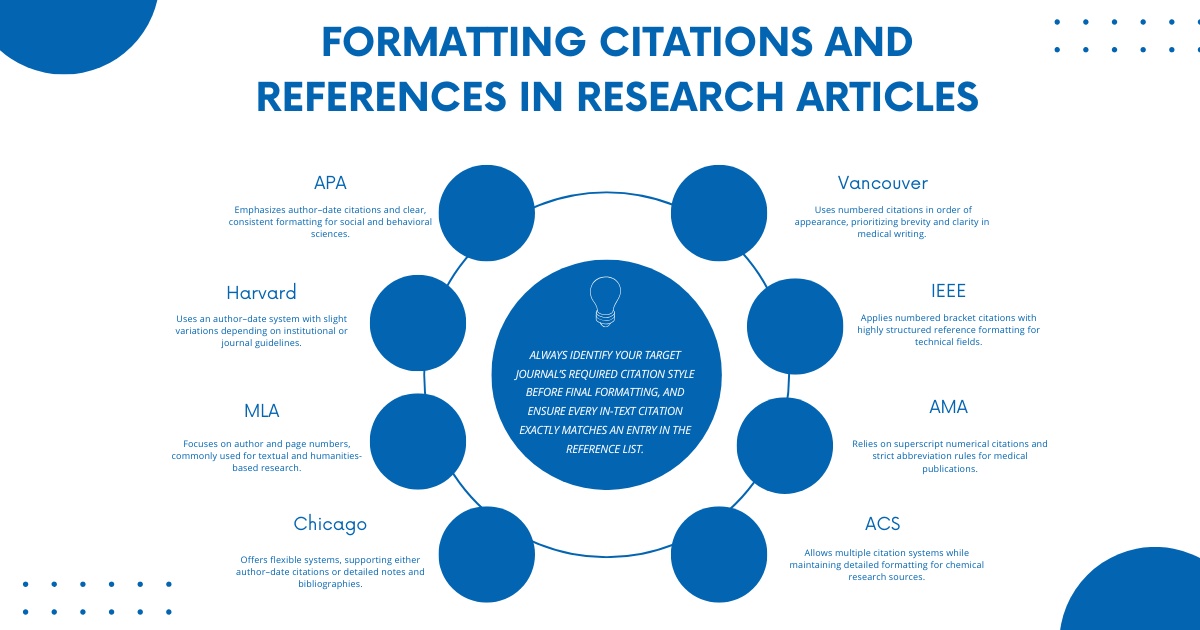
There is no single universal citation style used by all journals. Instead, styles vary by discipline, publisher, and journal policy. Below are the most widely used citation and referencing styles in academic publishing.
APA (American Psychological Association)
Commonly used in:
Psychology, education, social sciences, behavioral sciences, health sciences
In-text citation format:
Author–date system
Example: (Smith, 2022)
Reference list characteristics:
Alphabetical order by author
Publication year immediately after author name
Emphasis on recency of sources
APA style focuses on clarity, conciseness, and date visibility, making it suitable for fields where current research is essential.
MLA (Modern Language Association)
Commonly used in:
Literature, humanities, language studies, cultural studies
In-text citation format:
Author–page number
Example: (Smith 45)
Reference list characteristics:
Titled “Works Cited”
Emphasis on authorship and textual sources
Minimal publication date emphasis
MLA is less common in scientific journals but remains standard in humanities research.
Chicago Style
Commonly used in:
History, arts, social sciences, interdisciplinary research
Two systems available:
Notes and Bibliography (footnotes/endnotes)
Author–Date system
Reference list characteristics:
Flexible formatting
Detailed source information
Suitable for archival and historical sources
Chicago style is often chosen for complex citation needs or historical documentation.
Harvard Style
Commonly used in:
Business, economics, social sciences, multidisciplinary journals
In-text citation format:
Author–date
Example: (Smith 2022)
Reference list characteristics:
Alphabetical order
Similar to APA but with institutional variations
No single official manual
Harvard style varies slightly between publishers, so journal-specific guidelines are especially important.
Vancouver Style
Commonly used in:
Medicine, nursing, clinical and health sciences
In-text citation format:
Numbered citations
Example: [1] or superscript¹
Reference list characteristics:
Ordered by citation appearance
Concise reference entries
Emphasis on efficiency and readability
Vancouver style is widely used in biomedical journals and clinical research.
IEEE (Institute of Electrical and Electronics Engineers)
Commonly used in:
Engineering, computer science, technology, applied sciences
In-text citation format:
Numbered brackets
Example: [1]
Reference list characteristics:
Ordered numerically
Abbreviated journal titles
Highly structured formatting
IEEE style prioritizes precision and consistency in technical fields.
AMA (American Medical Association)
Commonly used in:
Medical and life sciences journals
In-text citation format:
Superscript numbers
Reference list characteristics:
Numbered by order of citation
Abbreviated journal names
Strict punctuation and formatting rules
AMA style is similar to Vancouver but has distinct formatting details.
ACS (American Chemical Society)
Commonly used in:
Chemistry and chemical engineering
In-text citation format:
Author–date, superscript, or numbered references (journal-specific)
Reference list characteristics:
Detailed chemical source information
Flexible citation options
ACS style varies depending on journal preference.
How to Identify the Correct Citation Style for Your Target Journal
Choosing the correct citation style should never be based on guesswork. Each journal specifies its required format.
Step 1: Check the Journal’s “Instructions for Authors”
Every reputable journal provides detailed author guidelines on its official website. Look specifically for sections titled:
Instructions for Authors
Manuscript Preparation
Reference Style
These sections explicitly state the required citation and reference format.
Step 2: Review Recently Published Articles
Examine 3–5 recent articles published in the journal. Pay attention to:
In-text citation format
Reference list structure
Punctuation, italics, and capitalization
This practical review often clarifies ambiguities not covered in guidelines.
Step 3: Identify Publisher-Level Requirements
Some publishers apply standardized citation styles across all their journals. Understanding publisher preferences helps avoid formatting inconsistencies.
Step 4: Confirm Submission System Instructions
Occasionally, submission platforms include additional technical requirements related to citation formatting, reference linking, or DOI inclusion.
Practical Guidelines for Formatting Citations and References
(Structures of Major Citation Styles)
The following tables summarize how citations and reference lists are structured in the most commonly used academic citation styles. Always follow the journal’s specific author guidelines, as small variations may apply.
APA Style (American Psychological Association)
Common fields: Social sciences, education, psychology, health sciences
In-Text Citation Structure (APA)
Type | Format | Example |
One author | (Author, Year) | (Smith, 2022) |
Two authors | (Author & Author, Year) | (Smith & Lee, 2021) |
Three or more authors | (Author et al., Year) | (Smith et al., 2020) |
Direct quote | (Author, Year, p. X) | (Smith, 2022, p. 45) |
Reference List Structure (APA)
Element | Format |
Author | Last name, Initials |
Year | (Year) |
Title | Sentence case |
Journal | Italicized |
Volume | Italicized |
Issue | In parentheses |
Pages | Page range |
DOI | Included when available |
Example:
Smith, J. A. (2022). Research methods in education. Journal of Education Research, 15(2), 120–135. https://doi.org/xx.xxx
Harvard Style
Common fields: Business, economics, multidisciplinary research
In-Text Citation Structure (Harvard)
Type | Format | Example |
One author | (Author Year) | (Smith 2022) |
Two authors | (Author and Author Year) | (Smith and Lee 2021) |
Multiple authors | (Author et al. Year) | (Smith et al. 2020) |
Reference List Structure (Harvard)
Element | Format |
Author | Last name, Initials |
Year | Year |
Title | Sentence case |
Journal | Italicized |
Volume | Volume number |
Issue | Issue number |
Pages | Page range |
Example:
Smith, J.A., 2022. Research methods in education. Journal of Education Research, 15(2), pp.120–135.
MLA Style (Modern Language Association)
Common fields: Humanities, literature, language studies
In-Text Citation Structure (MLA)
Type | Format | Example |
General citation | (Author Page) | (Smith 45) |
Reference List Structure (MLA – “Works Cited”)
Element | Format |
Author | Last name, First name |
Title | In quotation marks |
Journal | Italicized |
Volume & Issue | Vol. X, no. Y |
Year | Year |
Pages | Page range |
Example:
Smith, John. “Research in Modern Education.” Journal of Humanities, vol. 15, no. 2, 2022, pp. 120–135.
Vancouver Style
Common fields: Medicine, health sciences, clinical research
In-Text Citation Structure (Vancouver)
Type | Format | Example |
Citation | Numbered | [1] or superscript¹ |
Reference List Structure (Vancouver)
Element | Format |
Order | Numerical order of appearance |
Author | Last name Initials |
Title | Sentence case |
Journal | Abbreviated |
Year | Year |
Volume | Volume |
Issue | Issue |
Pages | Page range |
Example:
Smith JA. Research methods in education. J Educ Res. 2022;15(2):120–135.
IEEE Style
Common fields: Engineering, computer science, technology
In-Text Citation Structure (IEEE)
Type | Format | Example |
Citation | Numbered brackets | [1] |
Reference List Structure (IEEE)
Element | Format |
Order | Numerical |
Author | Initials. Last name |
Title | In quotation marks |
Journal | Italicized |
Volume | vol. X |
Issue | no. Y |
Pages | pp. X–Y |
Year | Year |
Example:
[1] J. A. Smith, “Research methods in education,” Journal of Education Research, vol. 15, no. 2, pp. 120–135, 2022.
Chicago Style (Author–Date)
Common fields: Social sciences, interdisciplinary research
In-Text Citation Structure (Chicago)
Type | Format | Example |
Citation | (Author Year) | (Smith 2022) |
Reference List Structure (Chicago)
Element | Format |
Author | Last name, First name |
Year | Year |
Title | Sentence case |
Journal | Italicized |
Volume | Volume |
Issue | Issue |
Pages | Page range |
AMA Style (American Medical Association)
Common fields: Medical and life sciences
In-Text Citation Structure (AMA)
Type | Format | Example |
Citation | Superscript number | ¹ |
Reference List Structure (AMA)
Element | Format |
Order | Numerical |
Author | Last name Initials |
Title | Sentence case |
Journal | Abbreviated |
Year | Year |
Volume | Volume |
Pages | Page range |
ACS Style (American Chemical Society)
Common fields: Chemistry, chemical engineering
In-Text Citation Options (ACS)
Option | Format |
Superscript | ¹ |
Author–date | (Smith, 2022) |
Numbered | [1] |
Reference List Structure (ACS)
Element | Format |
Author | Last name, Initials |
Title | Sentence case |
Journal | Italicized |
Year | Year |
Volume | Volume |
Pages | Page range |
Final Practical Note
Always remember:
Never mix citation styles
Follow the journal’s exact guideline
Check recent published articles
Perform a final manual review even if using reference software
Ensure Your Paper Meets Professional Standards with SITA Academy
SITA Academy offers expert citation and reference formatting services for all major styles, including: APA, Harvard, MLA, Vancouver, IEEE, Chicago (Author–Date), AMA, and ACS. Simply send us your paper along with your required citation style—or the journal you’re submitting to—and our team will format your references accurately and professionally.
Verified Contact Channels
If you have any questions, inquiries, or would like to learn more about our services, please don't hesitate to reach out to us. Our dedicated team is ready to assist you.