What Is a Q1 Journal? Meaning, Examples, and Why It Matters
Learn what Q1 journals are, why they matter, examples across fields, and practical tips to get your paper accepted in top 25% high-impact journals.
For researchers, publishing in reputable journals is one of the most important milestones in an academic career. Among the multitude of journals available, Q1 journals are highly sought after. But what exactly are they? Why do researchers strive to publish in them, and how can you increase your chances of getting your paper accepted? This article explains Q1 journals in simple, practical terms, covering their meaning, examples across disciplines, why they matter, and strategies for successful publication.
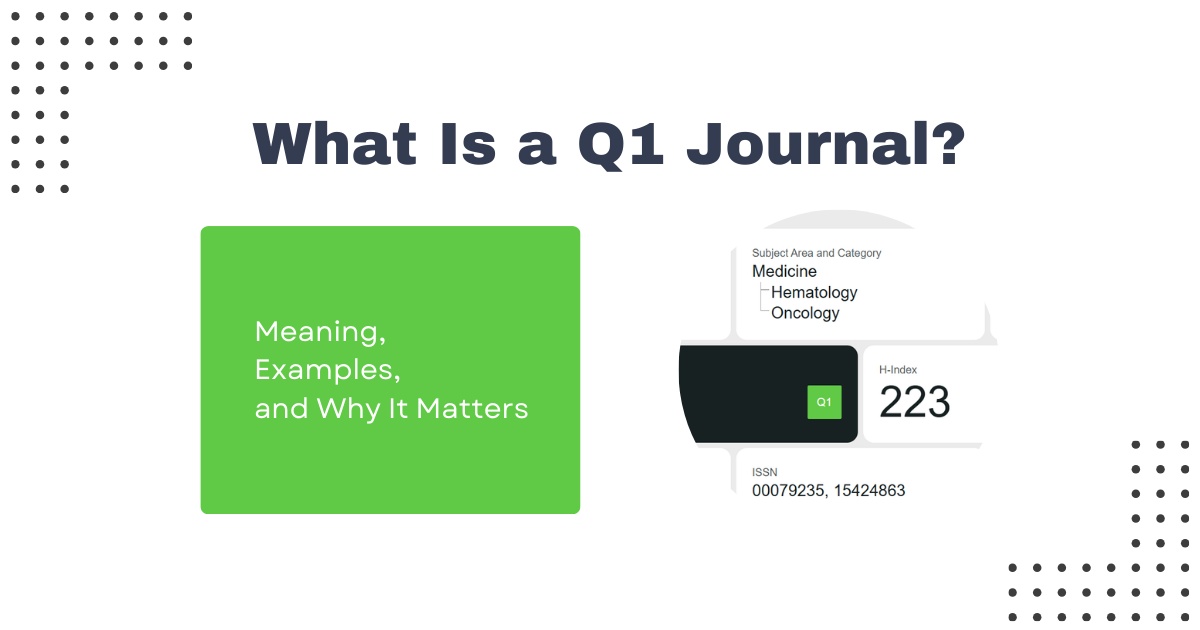
The term Q1 journal refers to journals ranked in the top 25% of their subject category based on citation metrics such as the Journal Impact Factor (JIF) or the Scimago Journal Rank (SJR). The letter “Q” stands for quartile, which is a statistical measure that divides all journals in a category into four equal groups:
Q1: Top 25% (highest impact and reputation)
Q2: 25–50%
Q3: 50–75%
Q4: Bottom 25%
These rankings are typically calculated annually and are based on the number of citations received, journal influence, and other bibliometric indicators. Publishing in a Q1 journal signals that your research meets high-quality standards, is widely cited, and contributes significantly to your field.
In contrast, Q2–Q4 journals are often still reputable, but they carry less visibility, fewer citations, and lower perceived impact. For early-career researchers, students, and academics seeking tenure or research funding, Q1 publications are highly valued.
Here are some examples of Q1 journals in different disciplines:
Science and Technology
Nature – A leading multidisciplinary journal known for publishing groundbreaking scientific research
Science – High-impact research across all fields of science
IEEE Transactions on Pattern Analysis and Machine Intelligence – A top engineering and computer science journal
Medicine and Health
The Lancet – Publishes high-impact clinical research globally
New England Journal of Medicine (NEJM) – One of the most prestigious journals in medicine
BMJ (British Medical Journal) – Covers medicine and healthcare research
Social Sciences and Humanities
Journal of Marketing – Publishes influential research in business and marketing
American Sociological Review – Leading journal in sociology
Journal of Political Economy – High-impact research in economics and social sciences
These journals are competitive, publish high-quality research, and have strong international readership, which increases your research visibility and credibility.
Related Article

Publishing in Q1 journals is more than just a prestige symbol. Here’s why they matter:
Academic Recognition:
Q1 publications demonstrate that your work meets high scholarly standards, earning recognition from peers and institutions.
Career Advancement:
Universities and research institutions often consider Q1 publications during promotion, tenure evaluations, and hiring decisions.
Higher Citations and Impact:
Q1 journals attract global readership, meaning your work is more likely to be cited, increasing your influence in the field.
Funding and Grants:
Many funding agencies prefer researchers with publications in high-impact journals, making Q1 publications advantageous for grant applications.
Global Visibility:
Q1 journals are widely read internationally, helping your research reach a broader audience and establish collaborations.
In short, Q1 journals provide recognition, career benefits, and greater influence, making them highly desirable for any researcher.
Publishing in Q1 journals is challenging but achievable with careful planning and execution. Here are practical steps to improve your chances:
Selecting a journal that aligns with your research is critical. Tips include:
Ensure your paper matches the journal’s scope and audience
Review recent publications to understand trends and standards
Decide whether to target open-access or subscription-based journals
Check the journal’s impact factor, indexing, and reputation
Q1 journals expect clarity, rigor, and novelty. Key components include:
Abstract: Concise summary highlighting your contribution
Introduction: Contextualizes the problem and explains significance
Methodology: Clear and reproducible methods
Results: Well-organized figures, tables, and data
Discussion: Emphasize significance, implications, and novelty
References: Include recent, high-quality citations
Proper formatting according to journal guidelines is essential to avoid desk rejection.
Q1 journals have stringent peer review processes. Reviewers evaluate:
Originality: Does the study offer new insights or methods?
Scientific Rigor: Are methods, experiments, and analyses robust and accurate?
Clarity and Organization: Is the paper well-structured and readable?
Ethical Compliance: Are conflicts of interest and research ethics properly disclosed?
Addressing these points strengthens your paper and improves the likelihood of acceptance.
Many papers are rejected due to preventable errors. Avoid:
Ignoring journal guidelines
Weak literature reviews or missing references
Poor English, grammar, or formatting
Submitting without internal peer feedback
A well-prepared, polished manuscript shows professionalism and respect for the journal’s standards.
Consult experienced colleagues or supervisors for guidance
Consider professional editing or pre-submission services
Incorporate feedback carefully before submission
These steps can significantly enhance the quality and acceptance potential of your paper.
Q1 journals represent the highest tier of academic publishing, offering recognition, visibility, and career benefits. Understanding their ranking, scope, and review process is essential for researchers aiming for high-impact publications.
While publishing in a Q1 journal is competitive, strategic planning—choosing the right journal, structuring your paper effectively, adhering to peer review expectations, and avoiding common mistakes—can significantly improve your chances.

Do you want to identify a relevant Q1 journal and increase your chances of successful publication? Send your abstract to our expert team. We will:
Review your abstract
Provide a list of high-acceptance journals suited to your research
Share expected peer review timelines and APC (Article Processing Charges)
If you have any questions, inquiries, or would like to learn more about our services, please don't hesitate to reach out to us. Our dedicated team is ready to assist you.